
n the commercial construction and large-scale infrastructure industry, financial management often centers on material procurement, heavy machinery costs, and critical path delivery windows. However, one of the factors that has the most significant direct impact on a project’s final profitability—and which is frequently underestimated during the initial budgeting phases—is the technical qualification of the subcontracted human capital. In the mechanical, electrical, and plumbing (MEP) sector, the decision to have certified master plumbers leading the job site is not an operational luxury, but a strategic financial risk mitigation play.
For a general contractor, evaluating subcontracting proposals based solely on the lowest price per linear foot installed is a common methodological error that usually leads to catastrophic cost overruns. Large-scale developments, such as multi-family residential complexes, high-rise towers, or hospitality projects, present complexities that require advanced technical supervision. Having master plumbers involved in the design, planning, and execution of these fluid networks ensures that the project’s cash flow is not compromised by operational inefficiencies, design flaws, or regulatory penalties.
The difference between technical labor and expert direction
To understand the true financial impact, it is necessary to distinguish between the various qualification levels within the plumbing trade. While apprentices and journeymen execute the physical tasks of installation and assembly, master plumbers possess advanced training in fluid engineering, complex system design, applied physics, and an encyclopedic understanding of local and international building codes.
This hierarchical and knowledge-based distinction translates into direct economic benefits for the construction firm. A commercial project lacking the oversight of experienced master plumbers is exposed to systemic failures in pipe diameter coordination, pressure drops at critical fixtures, and accelerated wear on booster pump systems due to incorrect hydraulic load calculations. The cost of repairing these deficiencies after walls have been closed and finishes have been installed can multiply the initial investment required to hire certified professionals tenfold.
Drastic reduction in change orders
In large-scale projects, change orders are the ultimate enemy of profitability. Most of these deviations from the original budget occur due to a lack of coordination between theoretical design blueprints and the physical reality of the job site. This is precisely where the early intervention of master plumbers transforms the financial landscape.
When a specialized subcontractor includes master plumbers within their pre-construction and project management teams, these professionals conduct a thorough review of the hydraulic blueprints in parallel with structural, mechanical (HVAC), and electrical plans. By identifying spatial clashes or regulatory inconsistencies before concrete is poured or materials are purchased, costly field delays are eliminated. Every clash resolved during the modeling or planning phase represents thousands of dollars retained within the general contractor's net profits.
Optimizing critical path timelines and site logistics
Time is money in commercial construction. A delay caused by one subcontractor triggers a domino effect that paralyzes drywall, paint, finishing, and electrical crews, accumulating idle labor costs and potential penalties for missing contractual deadlines. Certified master plumbers do not just understand piping networks; they master project management and job site logistics.
The ability to plan modular installations, coordinate the prefabrication of sanitary waste manifolds and bathroom batteries in controlled off-site shops, and manage just-in-time supply chains are core competencies of commercial-level master plumbers. This operational efficiency can reduce field installation timelines by 30% to 40%, clearing work zones faster and allowing the general contractor to keep the master project schedule under strict control.
Guaranteeing code compliance and seamless inspection approvals
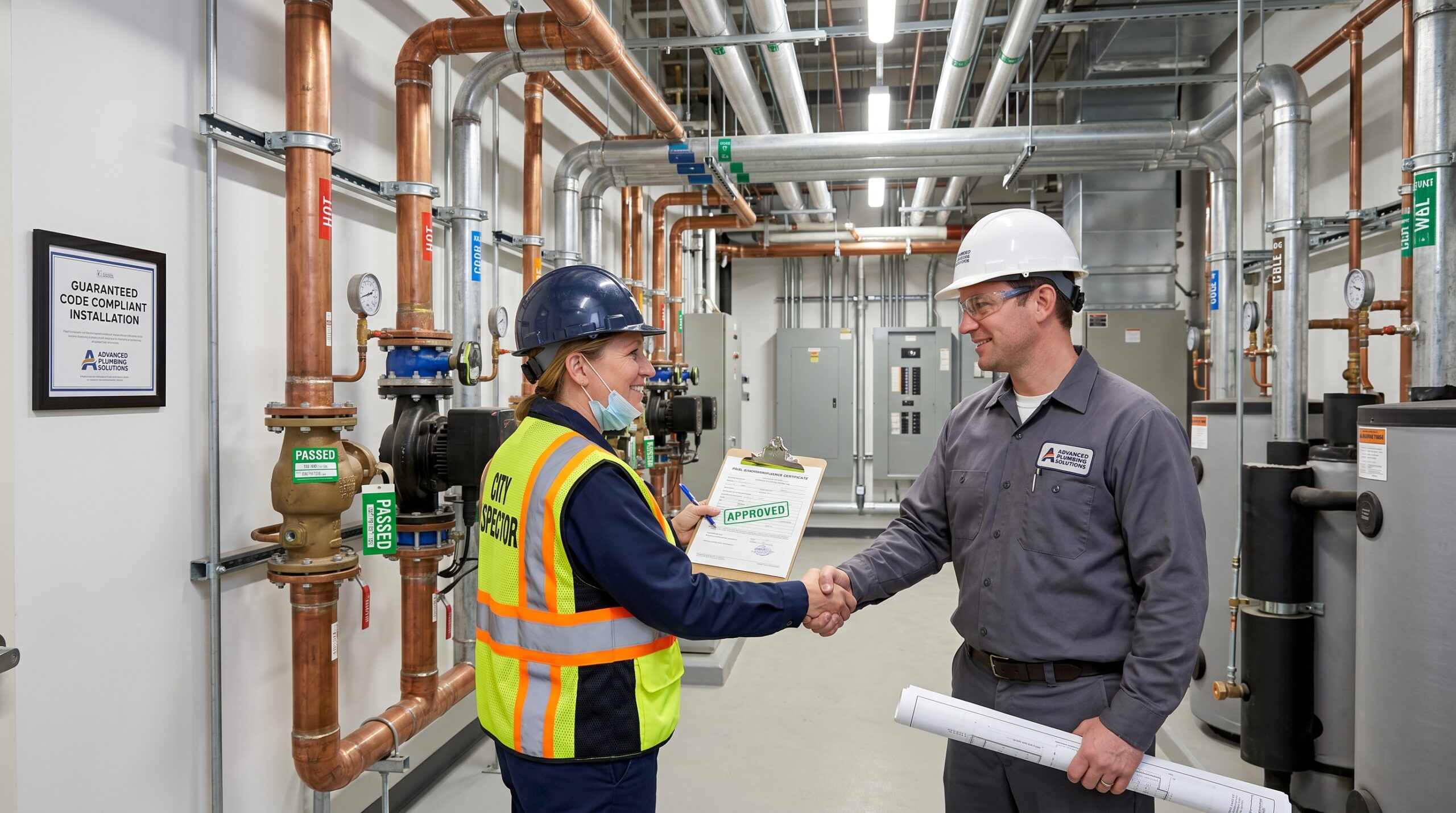
One of the most feared financial bottlenecks in multi-family and industrial developments across South Florida is the municipal inspection phase. A local building inspector who discovers a violation of the Florida Building Code or the International Plumbing Code (IPC) has the authority to halt the job immediately, demand the demolition of installed systems, and delay the issuance of the Certificate of Occupancy.
Avoiding fines: Infractions against hydraulic codes carry severe financial penalties from county regulatory agencies.
Seamless inspections: Qualified master plumbers design and execute pressure, smoke, and flow tests following the exact protocols required by law, guaranteeing first-visit approvals.
Permit execution: Their signature and active license serve as the legal backing before government entities, accelerating the bureaucratic paperwork that often stalls handovers.
The legal and technical security that master plumbers bring eliminates financial uncertainty during the project closeout phase, allowing developers to begin collecting rent or turning over units to buyers exactly on schedule.
The value of bonding capacity and commercial liability insurance
Bonding capacity and commercial liability insurance thresholds are two indispensable prerequisites for bidding on projects valued in the millions of dollars. Insurance underwriting firms evaluate a plumbing contractor’s risk profile largely based on the number of active master plumbers integrated into their corporate structure.
A subcontractor backed by veteran master plumbers with an unblemished record of technical compliance gains access to high-coverage insurance policies and more robust performance bonds. For the general contractor, this represents a total financial shield. In the highly unlikely event of a catastrophic system failure, commercial insurance absorbs the economic impact, protecting the main construction firm’s assets and reputation from third-party or investor claims.
Value engineering applied to material efficiency
Finally, the financial impact reflects directly on the hard cost of materials. An oversized hydraulic design uses more copper, steel, advanced polymers, and fittings than necessary, bloating the project’s material costs without adding any real technical benefit. Conversely, an undersized system will fail under operational stress.
Seasoned master plumbers apply value engineering principles to find the exact sweet spot. Utilizing their advanced knowledge, they optimize pipe routing, select materials with the best cost-to-durability ratio for each specific zone of the building, and specify energy-efficient booster systems that lower long-term utility costs for future owners—adding intrinsic commercial value to the real estate asset.

Subcontracting firms that feature the backing of experienced master plumbers should not be viewed as an additional operational expense, but as the most profitable preventive investment within a large-scale project budget. Their intervention is the ultimate guarantee that the project will be delivered on time, within budget, and under the highest quality and safety standards in the market.